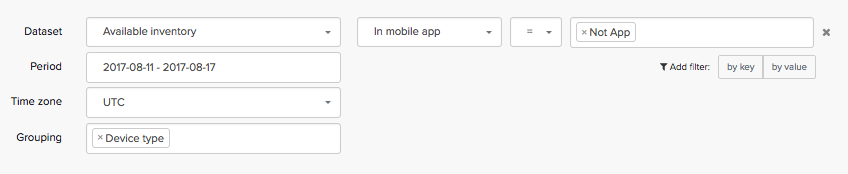
Unique users – unique visitors of anadvertiser's site who are found and marked by a Getintent pixel in a set period (a period could be set manually whencreating / configuring retargeting segments. A default period is 30 days). An audience collects after the installation of a Getintent pixel on theadvertiser's site and setting of a retargeting segment. The number of impressions - the predicted maximum number of banner impressions on different SSPs for the collected audience of an advertiser's website (RTB technology allows forecasting an available traffic of the audience of an advertiser's website). |
How long does it take to collect a retargeting segment?
An audience collecting starts after the installation of a Getintent pixel on the advertiser's site and setting of a retargeting segment. You can set up the period of collecting while creating/editing a segment. |
This situation shows that the advertiser’s users mostly visit sites that are not present in our SSPs. This happens due to the fact that all the SSPs, connected to Getintent, do not cover 100% of the Internet traffic. |
If you don’t use external click-tracking systems, you should enter a link to the landing page with all the utm-tags in the “Landing page” field. If you use an external click-tracking system, enter an external system’s click-link in the "Landing page" field and a website’s URL in the "Landing domain" field.
Examples:
Let’s take a look at the advertisingof https://www.google.ru/ example with and without using an external click-tracking system link: Without using an external click-tracking system link:
Using an external click-tracking system link:
|
CPC optimization – an advertising campaign placement optimization aimed at reaching a target click price. CPC optimization and predict activate when selecting the “Target_CPC” campaign strategy. CPC predict algorithms analyze pairs of parameters (e.g.: browser / creative, domain / creative, etc.) and calculate the probability of clicks in certain pairs.
|
The system automatically predicts a campaign’s budget execution. This forecast is based on the settings specified in the targeting and the speed of campaign budget spending.
|
If there is a need to change the strategy of the campaign, it is better to stop the current campaign and to start a new one with a new strategy. In this case, the system will work more efficiently. |
Information about the status of the campaign and the forecast is updated in 15-20 minutes. Real-time statistics are available in the "Statistics" tab in the campaign. There is no time lag. Statistics in the Report Builder appears one hour after the start of the campaign |
As well as the campaign’s status it is updated every 15-20 minutes. |
One of the most popular problems of our clients, is that the campaign does implement the whole budget after launch.
What to do:
More info you can find here - The most common mistakes |
This feature is available, but it is not present in the interface (we are working on it). To start targeting on IP contact our manager or use the feedback form in our interface.
|
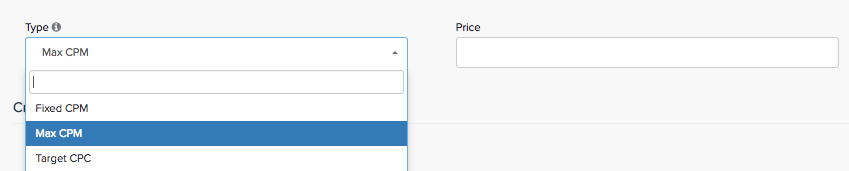
Max CPM – a standard scheme of work on RTB (second price auction). An advertiser specifies the maximum rate, and the auction will be won by the previous bid +1 (kopeck or a cent). In other words, an advertiser specifies the maximum value of CPM, which he is willing to spend on this campaign and gets traffic at a cost that is lower than the set value. This strategy should be used to maximize the amount of traffic and when using data segments.
Statistics is used for all campaigns of an advertiser. If the first campaign launched by an advertiser is a Target_CPC, the system will take over the raw data statistics of advertisers of similar subjects, until the system reaches enough statistics. This strategy is better to use only in campaigns targeted on the entire network or domains. When working with the segments, it may not work correctly, because 3rd-party segments limit the work of our prediction algorithms from the outside. |
At the moment there is no possibility of crossing segments (unfortunately, as experience has shown, the audience is narrowed too much, and a campaign stop running). |
DSP Getintent provides its customers with the possibility of placing creatives on two types of traffic:
|
DSP Getintent provides its customers with the possibility of placing creatives on two types of traffic: The advantages are:
|
Technically, we do not impose any restrictions on a minimal budget. But, as practice shows, the budget of 2000$ is a minimum for collecting the required amount of statistics and testing multiple strategies. A common problem is that advertisers launch campaigns with small budgets and the algorithms do not accumulate the necessary statistics for a full optimization. The result - a customer is unhappy, though, spending a larger budget would improve results dramatically. |
Yes of course. Send more information on the traffic volume, as well as technical specifications. |
In Getintent there is a possibility to choose different types of access to customers: Agency_client - an advertiser sees all the final rates and numbers. Agency commission is hidden for him. No_money_reports - an advertiser sees only quantitative indicators of the traffic. Everything that is connected with money is hidden. Only_campaign_list - the client sees only a list of campaigns, but can not see the settings of these campaigns |
We will add this feature in the near future. |
When using RTB, traffic is constantly changing. Changes may be caused by platforms (they provide different amount of traffic, change prices, etc), and by advertisers (several major advertisers participated in this auction so it warmed up).
|